Best Blinds for Large Windows and Sliding Doors Melbourne
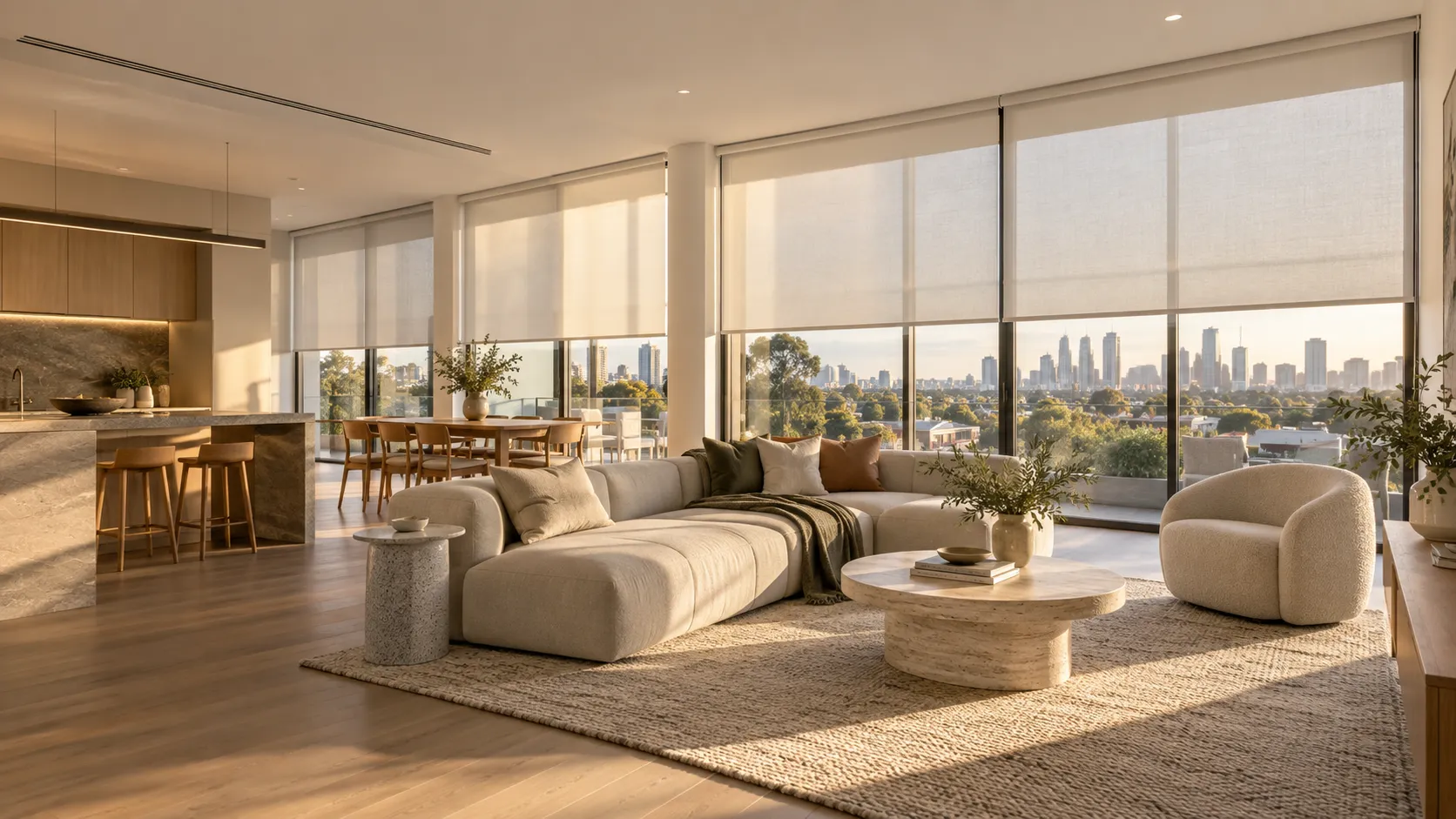
Large windows and sliding doors are one of the defining features of contemporary Melbourne homes – but they also present one of the biggest blind selection challenges. Standard blind solutions designed for regular windows often fall short when applied to oversized openings, wide sliding doors, or floor-to-ceiling glazing. In this guide we cover the best blind options for large windows and sliding doors in Melbourne – including which products work, which to avoid, and what to consider for different room types and orientations.
Why Large Windows Need Special Consideration
Most blind types have practical width limitations – roller blinds, for example, are typically available as single blinds up to around 2,400-2,700mm wide before fabric, tube weight, and operation become problematic. Beyond these widths, a single blind starts to sag, operate unevenly, or look awkward against the window. Sliding doors present additional challenges – the blind needs to allow door operation without getting in the way, handle frequent daily use, and ideally provide adjustable light control and privacy as needed throughout the day.
Melbourne’s new build estates in Clyde North, Berwick, and Box Hill, as well as established inner suburbs like Hawthorn and South Yarra, increasingly feature large-format glazing as a design element. Getting the right blind for these openings makes a significant visual and practical difference.
Best Blinds for Large Windows Melbourne
1. Double Roller Blinds – Most Popular for Large Living Areas
Double roller blinds – combining a sunscreen or sheer layer with a blockout layer on a single dual bracket – are the most popular choice for large windows in Melbourne living areas and open-plan spaces. For wide windows, double roller blinds can be installed as two or three linked blinds across the one window opening – each blind operating on its own tube but sharing a fascia or pelmet that gives the appearance of one continuous window treatment. This approach handles virtually any window width while maintaining smooth, practical operation.
Best for: Large living room windows, floor-to-ceiling glazing, open-plan dining areas, home office windows
Width options: Up to 2,700mm as a single blind – wider openings use linked multiple blinds sharing one fascia
Starting from: $200 per blind – contact Skyline Shades for multi-blind linked system pricing
2. Panel Glide Blinds – Best for Wide Sliding Doors
Panel glide blinds are the purpose-built solution for wide sliding doors in Melbourne homes. Rather than a fabric that rolls up and down, panel glides use wide fabric panels – typically 600-900mm wide – that slide horizontally along a track, mimicking the operation of the sliding door itself. Panel glides are available in single, double, and triple track systems – allowing multiple panels to stack behind each other when open, providing full door access. In a double track system, one track carries a sheer fabric and the other carries a blockout, giving you the same day/night flexibility as double roller blinds but in a format specifically designed for sliding door openings.
Best for: Wide sliding doors, stacker doors, bi-fold door openings, large bedroom windows
Width options: Effectively unlimited – panels are added to cover any width
Key advantage: Panels stack neatly to one side when open, allowing full door access
3. Motorised Roller Blinds – Best for Hard-to-Reach Large Windows
For very large windows, high windows, or skylights where manual operation is impractical, motorised roller blinds are the clear choice. A motorised system removes the need for long cord runs on large blinds – which become heavy and awkward on wide, tall openings – and allows the blind to be operated by remote, app, or voice command regardless of where it’s positioned in the room. Motorised roller blinds are increasingly specified in Clyde North new builds and Melbourne renovation projects for feature walls of glazing – where operating multiple large blinds manually every day would be frustrating.
Best for: Floor-to-ceiling windows, skylights, high windows, feature glazing walls, hard-to-reach openings
Motorisation from: $100 per motor added to any roller blind
Smart home compatible: Google Home, Alexa, Apple HomeKit
4. Plantation Shutters – Premium Option for Large Windows
Plantation shutters work beautifully on large windows when specified correctly – with panels divided into manageable widths (typically 600-900mm per panel) and joined by a central divider rail on very tall windows. For large windows in Melbourne living areas and master bedrooms, plantation shutters deliver superior light control through adjustable louvres, complete privacy, and a clean architectural finish that other blind types can’t replicate.
The key for large windows is specifying the right panel configuration – too few panels at too wide a width results in warping over time. Skyline Shades recommends professional measuring for all plantation shutter installations to ensure panel widths are correctly specified.
Best for: Large bedroom windows, living room feature windows, bay windows
PVC shutters from: $230 per shutter panel
Important: Professional measuring essential for large window shutter installations
5. Venetian Blinds – Best for Wide Windows Requiring Precise Light Control
For wide windows in kitchens, home offices, and rooms where precise light direction control matters, timber or aluminium venetian blinds with reinforced headrails provide excellent coverage across large openings. Wide venetian blinds should always be specified with a reinforced or double headrail to prevent sagging across the span. For very wide openings, two venetian blinds meeting at the centre is a more practical solution than a single oversized blind.
Best for: Wide kitchen windows, home office windows, dining room windows requiring directional light control
Width options: Single blinds up to approximately 2,400mm with reinforced headrail
Best Blinds for Sliding Doors Melbourne
Sliding doors require blinds that allow door operation without the blind getting in the way – and that handle the frequent daily use sliding doors receive.
Option 1 – Panel Glide Blinds (Recommended)
As covered above, panel glides are purpose-built for sliding doors. The panels slide horizontally to one side — the same direction as the door — allowing the door to operate freely. The most practical and purpose-designed solution for sliding door blinds in Melbourne.
Option 2 – Double Roller Blinds
A double roller blind positioned above a sliding door – one sunscreen, one blockout – is a popular and cost-effective alternative to panel glides for standard sliding doors. The blind mounts above the door frame and raises fully when the door needs to be used. Best for doors used less frequently or where panel glides don’t suit the room’s aesthetic.
Option 3 – Vertical Blinds
Vertical blinds are a traditional sliding door solution – slats hang vertically and part to the side to allow door access. Less popular in contemporary Melbourne interiors but practical for very wide openings and budget-conscious applications.
Option 4 – Plantation Shutters (bifold configuration)
For sliding door openings in premium Melbourne homes, plantation shutters configured in a bifold arrangement fold back against the wall when the door is in use. The most premium sliding door solution – but also the most expensive and requires adequate wall space for the shutters to fold back into.
What to Avoid for Large Windows and Sliding Doors
Single roller blinds on very wide openings – a single roller blind wider than 2,700mm will sag in the middle, operate unevenly, and look awkward. Always use linked multiple blinds with a shared fascia.
Roman blinds on sliding doors – roman blinds fold upward into a stack when raised, which works well on windows but creates an awkward bulky fold above sliding doors. Roller blinds or panel glides are the better choice.
Standard venetian blinds without reinforced headrails – wide venetian blinds without headrail reinforcement will sag and warp over time, particularly in Melbourne’s temperature extremes.
Fabric curtains without appropriate track systems – heavy floor-to-ceiling curtains on sliding doors need a robust, smooth-running track to handle daily use without the rings jamming or the track sagging.
North and West-Facing Large Windows in Melbourne – Special Considerations
Melbourne’s north and west-facing large windows receive the most direct sun – making fabric and openness level selection particularly important.
North-facing large windows – receive strong midday sun year-round. Sunscreen roller blinds (3%-5% openness) or double roller blinds with a sunscreen layer are ideal – UV protection with maintained view.
West-facing large windows – receive intense late afternoon sun, particularly in Melbourne’s summer. A lower openness sunscreen (1%-3%) or blockout roller blind is recommended for west-facing living areas. Motorised operation is particularly valuable for west-facing windows – the blind can be scheduled to lower automatically in the afternoon without manual intervention.
Frequently Asked Questions – Blinds for Large Windows Melbourne
Q: What is the widest single roller blind available in Melbourne?
Standard custom roller blinds are typically manufactured up to 2,700mm wide as a single blind. Beyond this width, the fabric weight and tube size make single-blind operation impractical. For openings wider than 2,700mm, Skyline Shades recommends linking two or three roller blinds under a shared fascia or pelmet – giving the appearance of one continuous blind while maintaining smooth, practical operation on each individual blind.
Q: What are the best blinds for sliding doors in Melbourne?
Panel glide blinds are the purpose-designed solution for sliding doors – fabric panels slide horizontally on a track, the same direction as the door, stacking neatly to one side when the door is in use. Double roller blinds are a popular and cost-effective alternative for standard sliding doors. Plantation shutters in a bifold configuration are the premium option for high-end Melbourne homes with adequate wall space.
Q: Can I use plantation shutters on a large sliding door in Melbourne?
Yes – plantation shutters can be configured for sliding door openings in a bifold arrangement that folds back against the wall when the door is in use. This requires adequate wall space on one or both sides of the door for the shutter panels to fold into. Professional measuring is essential for shutter installations on sliding doors to ensure the panel configuration works with your specific door and room layout.
Q: Are motorised blinds better for large windows?
Yes – for large, wide, or hard-to-reach windows, motorised blinds are significantly more practical than manual alternatives. Long cord runs on large manual blinds become heavy and awkward, particularly on floor-to-ceiling or very wide openings. Motorised systems remove this issue entirely – the blind operates smoothly via remote, app, or voice command regardless of size or position. Motorisation starts from $100 per motor at Skyline Shades.
Q: How do I choose between panel glides and roller blinds for my sliding door?
Panel glides are the better choice for frequently used sliding doors – the horizontal sliding action mirrors the door operation and allows full door access without raising the blind. Roller blinds suit sliding doors used less frequently, or where the room aesthetic suits a roller blind better than panels. During your free in-home consultation, Skyline Shades will assess your specific door and recommend the most practical option for your usage and design preferences.